
Power is now the bottleneck in AI data centers – not compute.
The industry has spent years optimising silicon, scaling GPU clusters all the while pushing model architectures to their limits. But there’s a constraint that doesn’t get the same attention: the power delivery systems feeding all that compute.
At weeteq, we’ve been working on a breakthrough that fundamentally changes that equation.
The Hidden Tax in Today’s Power Architectures
Modern GPUs and AI accelerators demand sub-microsecond load transient response, aggressive dynamic voltage and frequency scaling (DVFS), and tighter regulation margins to control runaway power consumption.
Conventional power architectures can’t respond fast enough to these dynamic loads. The typical path – 48v to 12v to 0.8v – introduces conversion stages that simply cannot keep pace with what modern AI silicon demands.
The workaround? Engineers add voltage margin. They run processors at higher voltages than theoretically necessary, just to ensure stability during transient events. This regulation margin is a hidden tax baked into every AI data center today – increasing steady-state power consumption and limiting system-level efficiency.

Introducing DIVA
DIVA – Dynamic Current (I) and Voltage control for ASICs – is a new power delivery architecture designed for high-performance AI and GPU/xPU workloads.
Rather than forcing a trade-off between efficiency and dynamic response, DIVA decouples them entirely through a parallel power delivery architecture combining two complementary paths:
High-Efficiency DC-DC Converter delivers average load power with optimal efficiency, supporting single-step conversion directly to the processor power domain.
Ultra-Fast DIVA Regulation Path supplies instantaneous load transients with response greater than 10 A/ns and enables dynamic voltage scaling faster than 10 mV/ns.
These two paths operate seamlessly in parallel. Average power is delivered efficiently, while fast transient events are handled locally and instantly – without forcing voltage over-margining.
The Numbers
DIVA enables operation at lower average power domain voltage while maintaining identical compute performance:
- Voltage reduction: 0.8V → 0.7V at the power domain
- Power domain consumption: ~30% reduction
- Compute tray power: 15 kW → 10 kW
- Rack power: 120 kW → 80 kW
- Compute output: Equivalent token throughput
The result: 40 kW savings per rack, reduced cooling burden, higher deployment density, and materially lower total cost of ownership.
Why This Matters Now
AI infrastructure is scaling rapidly. Data centres are pushing toward megawatt-scale racks, and the industry is transitioning from 48V/54V to 800V DC architectures to manage the sheer current demands. But voltage conversion is only part of the problem.
The real inefficiency sits at the final stage – where power meets silicon. That’s where voltage margins compound into kilowatts of waste, multiplied across thousands of GPUs.
DIVA addresses this directly. It’s scalable from 48V to 800V DC environments, and it delivers benefits at every level – from silicon to rack.
A Step Change, Not an Incremental Tweak
Conventional architectures trade efficiency for stability. Ultra Edge® DIVA delivers both, at scale.
This isn’t about squeezing another percentage point of efficiency from existing approaches. It’s a step change in how power is delivered to AI compute.
Glasgow, Scotland – 12th December 2025
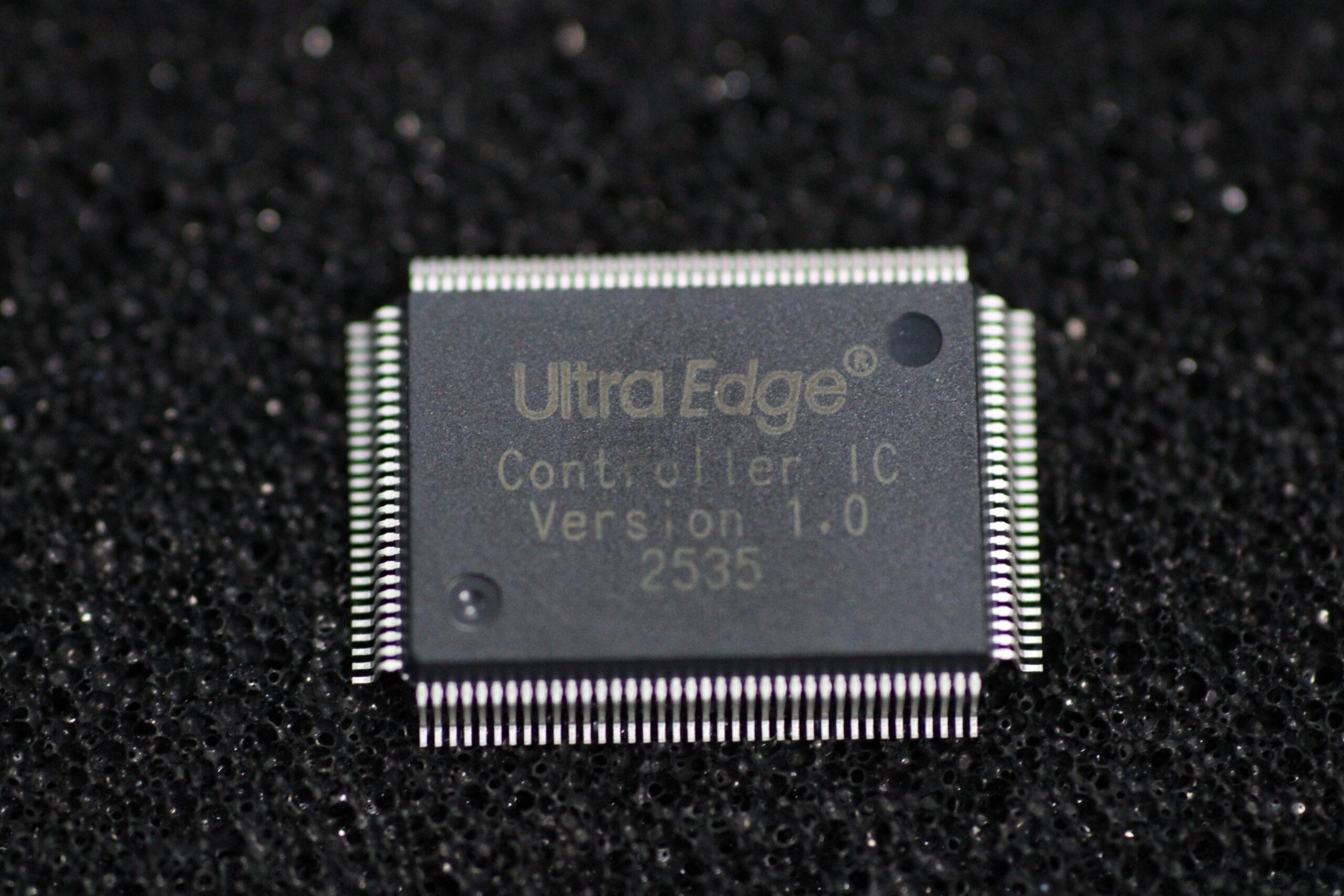
Today marks a huge milestone for weeteq – our first Ultra Edge® silicon chip is finally on the bench, built to push the boundaries of what’s possible in power and control system optimisation.
This is more than just a technical achievement. It’s validation that our vision – circuit-level AI operating at sub-0.1 millisecond speeds is now ready for customers to experience its potential.
A Team and Ecosystem Achievement
Getting here has taken a committed team and an ecosystem of innovative, talented, and passionate partners. We’re truly grateful to everyone who has supported the journey so far.
A huge thanks to Silicon Catalyst, SMD Semiconductor, NXP Semiconductors, Arm, TSMC, Synopsys Inc, MathWorks, and imec for their technical collaboration and expertise in bringing Ultra Edge® silicon to reality.
We’re also grateful for the funding and commercialisation support from Scottish Enterprise, STAC, Scintilla, AAB, and MPA, alongside backing from our early-stage investors and pilot customers who believed in the technology before silicon existed.
Special thanks to Sean Redmond, Board Observer and UK & EU Managing Director at Silicon Catalyst, for being such a supportive figure in the weeteq story.
What This Means: 2026 and Beyond
With silicon now on the bench, we’re ready to accelerate customer engagement across three strategic markets where Ultra Edge® delivers transformative impact:
Grid Stability – Our grid-forming power converters enable distributed synthetic inertia with sub-0.1 millisecond response times, helping utilities integrate renewable energy without billion-pound infrastructure investments.
Automotive Electrification – Circuit-level optimisation delivers enhanced powertrain efficiency, 100% fault detection coverage for safety-critical systems, and significant component cost reduction for electric and autonomous vehicles.
AI Data Centre Infrastructure – Ultra Edge® DIVA (Dynamic current & Voltage control for ASICs) supports emerging 800V DC architectures, unlocking GPU performance through intelligent power delivery and enabling the sustainable AI data centres of the future.
2026 is already shaping up to be huge. With our own test silicon, advanced customer discussions across multiple verticals, and a clear path to commercial scale, we’re positioned to play a pivotal role in stabilising electrical grids, driving automotive electrification, and transforming data centre power delivery.
The Technology
Ultra Edge® processes operational data at the circuit level – eliminating the need for external sensors or cloud infrastructure while achieving response times that conventional systems simply can’t match.
It’s an exciting time to be working with weeteq. If you’re interested in exploring how Ultra Edge® can transform your power and control systems, we’d love to hear from you.
Milan, Italy – 3rd July 2025
Last week, our COO Martin MacDonald joined industry leaders at the Edge AI Foundation Milan 2025 event to share why the industry’s push toward edge computing is still missing the mark for real-time control applications.
The Latency Problem No One’s Talking About
The event brought together experts sharing their beliefs for Edge AI computing moving forward. weeteq’s message cut through the noise: while everyone argues about moving computation closer to devices, they’re overlooking a fundamental physics problem.
Real-time control happens in microseconds. By the time data travels to the “edge”—no matter how close you place it—the critical moment for optimisation has already passed.
Our Circuit-Level Solution
Martin demonstrated how Ultra Edge® addresses this through a fundamentally different approach:
- Optimisation within the circuit – processing happens inside the target device itself, not at an external edge node
- Sub-100 microsecond response times – fast enough to change control loop responses in real-time, not after the fact
- Light-touch integration – works with existing architectures without requiring system redesign
- No historical training required – leverages existing circuit-level operational data that’s already available
From Reactive to Predictive
This circuit-level approach transforms how power and control systems operate—moving from reactive monitoring to predictive correction. Systems self-correct before issues manifest at the sensor level, fundamentally changing what’s possible in industrial automation, automotive, and grid applications.
Martin’s closing thought resonated with the Milan audience: “While the industry debates where to put the edge, we’re proving the real future is intelligence that responds before traditional systems even know there’s a problem.”
Interested in Circuit-Level AI?
If you’re working on embedded systems, motor control, or power electronics applications and want to explore how Ultra Edge® addresses ultra-low latency requirements, we’d love to continue the conversation.

As an official Arm partner and member of the Arm Flexible Access program, weeteq has been able to rapidly progress product development from technical concept to our own silicon.
Arm Flexible Access provided immediate access to Arm Cortex-M55, Ethos-U55, and Corstone-300 technology, enabling weeteq to prototype, validate, and tape out our own silicon without the overhead of traditional licensing arrangements. Arm’s partnership has proven essential in reducing technical risk and accelerating our development timeline.
The result? Significantly faster go-to-market time for our Ultra Edge® technology. What would typically take years in traditional semiconductor development, we have achieved in months – meaning we can get our circuit-level AI solutions into our customers’ hands much faster.
A huge thank you to Arm who have supported the journey of circuit-level AI optimisation from the very beginning.
