
weeteq has been selected to join the SUITE project – a major collaborative R&D programme funded through the DRIVE35 Collaborate competition, delivered by the Advanced Propulsion Centre (APC) and Innovate UK on behalf of the Department for Business and Trade.
The SUITE consortium is led by Nissan Motor Manufacturing UK and brings together industry and academic partners to develop technologies that improve the efficiency and range of next-generation electric vehicles.
What we are working on
As part of the SUITE consortium, weeteq is applying Ultra Edge® to advanced powertrain systems for electric vehicles. Our circuit-level AI enables real-time power and control optimisation at the point of dynamic changes – making power electronics faster, more efficient, and more responsive to the demands of EV drivetrains.
It is an opportunity to work alongside some of the most respected names in automotive engineering and academic research, and to demonstrate what Ultra Edge® can deliver for the automotive industry.
The consortium
SUITE is one of five collaborative R&D projects sharing over £84 million of total investment – including over £42 million in grant funding matched by industry. The consortium partners are:
- Nissan Motor Manufacturing UK (lead partner)
- Ricardo UK
- RAM Innovations
- Oxford PV
- Newcastle University
- University of Oxford
- University of Bristol
- University of Nottingham
- University College London
What this means for weeteq
Being part of SUITE is a significant step. The DRIVE35 Collaborate programme funds late-stage R&D projects on their path to commercialisation, and being selected alongside a global OEM and tier-one engineering partners validates the work we have been doing since day one – building semiconductor technology in the UK that has a real role to play in the electrification of transport.
We will share more about our specific contributions as the project progresses. For the full list of projects announced in this round, the APC has published an overview on their website.
The SUITE project is funded through the DRIVE35 Collaborate programme, delivered by the Advanced Propulsion Centre and Innovate UK on behalf of the Department for Business and Trade.
In 2022, 5G3i LTD rebranded as weeteq. A new name for what we do to better represent our innovative ‘wee’ technology.
Our Corporate Structure
Alongside the rebrand, the company established a clearer corporate structure to support international growth:
- 5G3i LTD remains the parent entity, now operating under the weeteq brand.
- weeteq LTD was established in the UK in 2022 as a wholly owned subsidiary.
- weeteq Inc was established in the US in 2025 as a wholly owned subsidiary.
This structure positions the company to serve customers and partners directly in both markets as we move from development into commercial deployment.
Same Team, Same Technology
The rebrand changed the name, not the work. The team behind Ultra Edge® – based in Glasgow – continues to develop and deliver circuit-level AI that makes power systems faster, more efficient, and more responsive. If you have been following 5G3i, you are already following weeteq.
For any questions about the rebrand or our corporate structure, get in touch at [email protected].
Nuremberg, Germany — 10th–12th March 2026 | Hall 2, Stand 2-412f
See Ultra Edge® in Action
weeteq will be exhibiting at Embedded World 2026, one of the world’s leading exhibitions for embedded systems and the technologies shaping the future of industrial and power electronics.
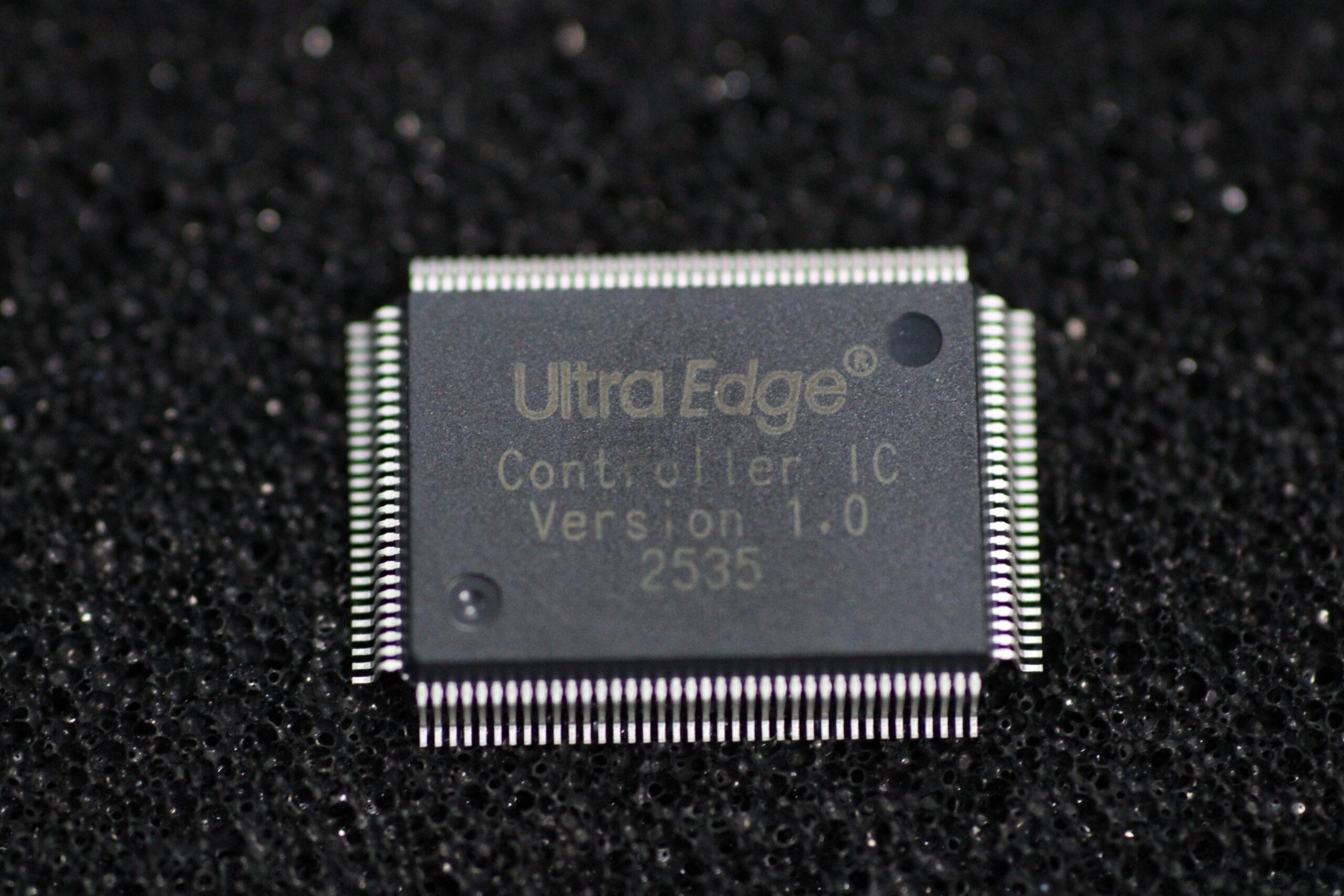
At our stand, we will be demonstrating the Ultra Edge® test chip for motor drives – delivering real-time, circuit-level AI power optimisation with response times of less than 0.1 milliseconds. This is a significant milestone for the company and a chance to see Ultra Edge® technology operating on live hardware.
What We’re Showcasing
Motor Drive Demonstration
Our Ultra Edge® test chip brings circuit-level AI directly into the power electronics of motor drive systems. Rather than relying on cloud-based analytics or post-event correction, Ultra Edge® detects, predicts and responds to system anomalies at the point they occur – within the circuit itself.
The result is measurable improvement in energy efficiency, reduced component stress, extended system lifespan and optimised performance, all achieved through a light-touch integration that works alongside existing control architectures. Motor drive designers no longer need to design regulation margins for the worst case scenario, with Ultra Edge® you can achieve equivalent performance with smaller components saving significant BOM cost in the process.
Power Infrastructure & Data Centre Solutions
Power Infrastructure & Data Centre Solutions
Beyond motor drives, we will be available to discuss how Ultra Edge® technology applies to data centre power delivery challenges. Our dual-path architecture addresses the fundamental trade-off between conversion efficiency and fast load transient response, reducing processor chip power by 30% and overall tray power consumption by 25%. As AI and HPC workloads drive demand for more tokens per watt, we welcome conversations with data centre architects and power engineers exploring smarter approaches to power delivery.
Whether you are working on power conversion, grid-connected systems or data centre energy efficiency, we welcome the opportunity to explore how our technology can support your objectives.
Visit Us
Location: Messe Nuremberg, Hall 2 — Stand 2-412f Dates: 10th–12th March 2026
To arrange a meeting ahead of the event, please contact us via our website or reach out directly on LinkedIn.
We look forward to seeing you in Nuremberg.
Power is now the bottleneck in AI data centers – not compute.
The industry has spent years optimising silicon, scaling GPU clusters all the while pushing model architectures to their limits. But there’s a constraint that doesn’t get the same attention: the power delivery systems feeding all that compute.
At weeteq, we’ve been working on a breakthrough that fundamentally changes that equation.
The Hidden Tax in Today’s Power Architectures
Modern GPUs and AI accelerators demand sub-microsecond load transient response, aggressive dynamic voltage and frequency scaling (DVFS), and tighter regulation margins to control runaway power consumption.
Conventional power architectures can’t respond fast enough to these dynamic loads. The typical path – 48v to 12v to 0.8v – introduces conversion stages that simply cannot keep pace with what modern AI silicon demands.
The workaround? Engineers add voltage margin. They run processors at higher voltages than theoretically necessary, just to ensure stability during transient events. This regulation margin is a hidden tax baked into every AI data center today – increasing steady-state power consumption and limiting system-level efficiency.

Introducing DIVA
DIVA – Dynamic Current (I) and Voltage control for ASICs – is a new power delivery architecture designed for high-performance AI and GPU/xPU workloads.
Rather than forcing a trade-off between efficiency and dynamic response, DIVA decouples them entirely through a parallel power delivery architecture combining two complementary paths:
High-Efficiency DC-DC Converter delivers average load power with optimal efficiency, supporting single-step conversion directly to the processor power domain.
Ultra-Fast DIVA Regulation Path supplies instantaneous load transients with response greater than 10 A/ns and enables dynamic voltage scaling faster than 10 mV/ns.
These two paths operate seamlessly in parallel. Average power is delivered efficiently, while fast transient events are handled locally and instantly – without forcing voltage over-margining.
The Numbers
DIVA enables operation at lower average power domain voltage while maintaining identical compute performance:
- Voltage reduction: 0.8V → 0.7V at the power domain
- Power domain consumption: ~30% reduction
- Compute tray power: 15 kW → 10 kW
- Rack power: 120 kW → 80 kW
- Compute output: Equivalent token throughput
The result: 40 kW savings per rack, reduced cooling burden, higher deployment density, and materially lower total cost of ownership.
Why This Matters Now
AI infrastructure is scaling rapidly. Data centres are pushing toward megawatt-scale racks, and the industry is transitioning from 48V/54V to 800V DC architectures to manage the sheer current demands. But voltage conversion is only part of the problem.
The real inefficiency sits at the final stage – where power meets silicon. That’s where voltage margins compound into kilowatts of waste, multiplied across thousands of GPUs.
DIVA addresses this directly. It’s scalable from 48V to 800V DC environments, and it delivers benefits at every level – from silicon to rack.
A Step Change, Not an Incremental Tweak
Conventional architectures trade efficiency for stability. Ultra Edge® DIVA delivers both, at scale.
This isn’t about squeezing another percentage point of efficiency from existing approaches. It’s a step change in how power is delivered to AI compute.